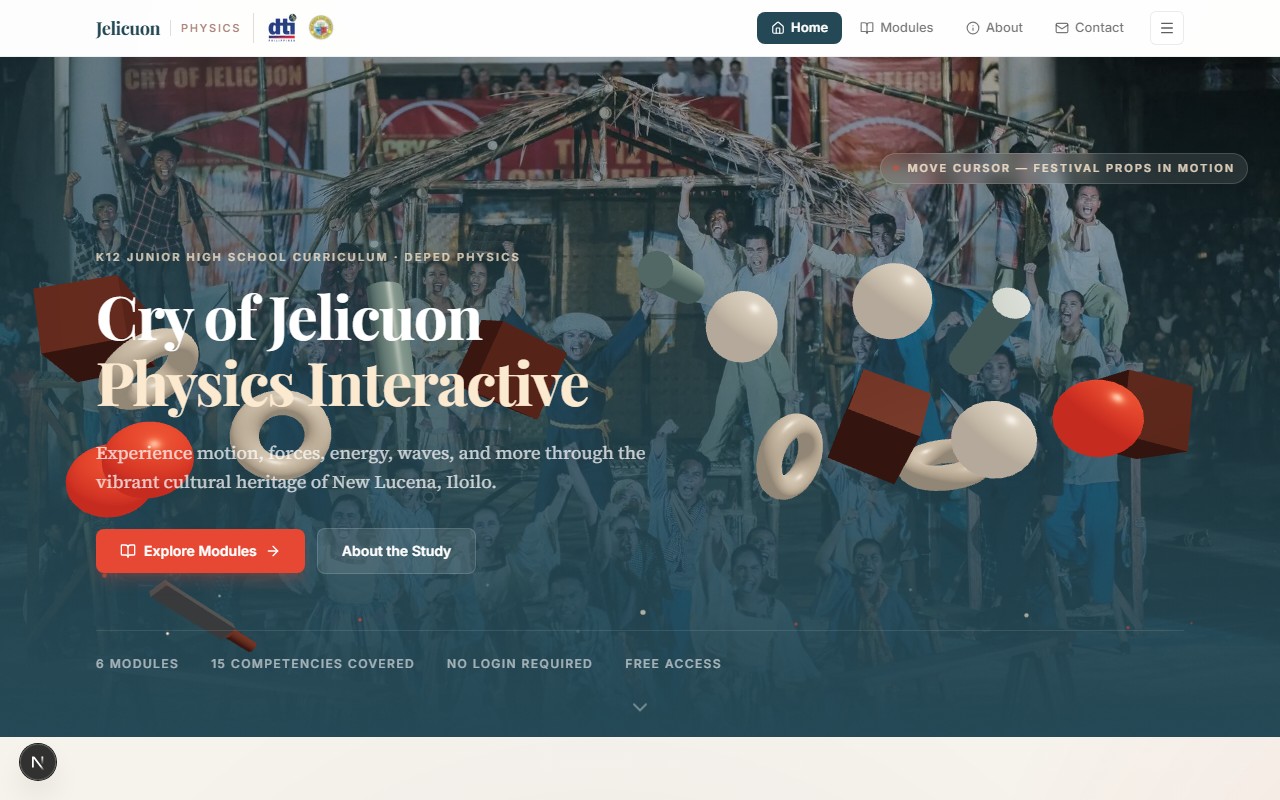
Cry of Jelicuon — Interactive Physics Platform
Turning a town's festival into a physics classroom — an e-learning package built to pass a DepEd expert panel.
Client
Jayne Paul Sucob — DepEd JHS Researcher, New Lucena, Iloilo
Year
2026
Role
Sole Developer
Why It Exists
In New Lucena, Iloilo, every year the town reenacts General Martin Delgado's 1898 revolt against colonial rule — the Cry of Jelicuon. Students build the risers, weld the prop rifles, and drill the choreography for weeks, then march it out under live drumlines. They live inside a working physics lab and never notice. Meanwhile, in the classroom, the same kids stare at v = Δx/Δt on a board and feel nothing. Jayne Paul Sucob, a DepEd Junior High science teacher there, spent a thesis trying to close that gap. He interviewed the festival's organisers and performers — the people who push the heavy platforms, the choreographers who introduce steps part by part, the LGU workers who climb to hang the flag — and catalogued the physics already embedded in what they do: kinematics in a performer's timed entrance, forces in a riser being shoved across a plaza, energy in a jump, momentum in a staged fight, resonance in a drumline, heat in the cool-down afterward. The research was done. What he didn't have was a way to put it in front of students — and a learning package an expert panel would evaluate, against DepEd's rating sheet for non-print materials, as fit to actually teach with. That's where I came in.
What I Built
I was contracted to build the whole platform solo — a Next.js e-learning site that turns his thesis into something a 13-year-old can click through. It ended up at 45 lessons across 6 modules, mapped to 15 specific DepEd competency codes the panel would check by hand. The decision I'm most glad I made early was to make everything data-driven. Every lesson — video, reading, or interactive simulator — is just a JSON object in data/modules. That meant the curriculum content was the researcher's to shape without touching React, and I could keep the rendering logic in a handful of components: a ConceptVisualizer that branches on the formula string to compute live outputs, a video player that pauses at timestamps to quiz you, cloze inputs embedded mid-paragraph so reading stays active. The piece I'm proudest of is the scene system — eight hand-built animated SVG scenes, registered by key, where the physics literally plays out in the festival's own imagery: a runner doing laps to show distance versus displacement, a cart hauled at an angle to decompose force, a jumper falling off a riser as the potential-to-kinetic energy bars trade places. Every lesson follows the same five-step rhythm — festival hook, competency code, the physics, an interactive sandbox, a discussion prompt — so the structure itself was defensible when the panel asked why it's organised that way.
Try it yourself
This one is live and open — no login.
Every module, simulator, and reading check is publicly accessible. Click through the physics scenes the same way a student would.
Open the live learning platformThe Hardest Part
The hardest lesson wasn't technical difficulty — it was realising what 'bug' even means in a teaching tool. The Stage Path Explorer is the simulator whose entire reason to exist is teaching that distance ≠ displacement. You set the laps, the runner runs, and you read off the two numbers. When the panel feedback came back, one comment stopped me cold: with decimal laps — say 2.5 laps on a 100 m track — displacement was reporting roughly zero. It should have been about 50 m, because the runner didn't return to start. I traced it to one line. At the end of the animation I was force-snapping the runner back to the start point regardless of fractional laps, then computing displacement from that snapped position. Trivial fix. But the implication wasn't trivial: my simulator had been confidently teaching the exact opposite of the concept it existed to teach. In an ordinary app, that's a cosmetic glitch you'd shrug at. In an instructional tool, it's the worst kind of bug there is — and any evaluator testing the distinction would hit it in the first thirty seconds. That reframed how I read the whole feedback document: a self-revealing quiz answer, a label overlapping on a sim, an animation that finishes faster than the eye can track — those aren't polish issues. Each one quietly teaches something wrong.
What I'd Do Differently
I'd build the standards coverage matrix before writing a single lesson, not after. I mapped the site to competency codes — S9FE-IIb-17 and the rest — and assumed that was alignment. It wasn't. Each DepEd competency carries a content standard (what students must know) and a performance standard (what they must be able to do), and the panel's real yardstick was those, not the codes. Mapping to codes got me a platform that looked complete and was quietly thin: no worked examples, no performance tasks, discussions only a paragraph or two deep. If I'd laid the standards out as a grid first and hung every lesson on it, that second wave of authoring work would have been the plan from day one instead of a correction.
The Impact
It's built and deployed — six modules, 45 lessons, every one of the 15 required competencies addressable through a simulator, a video, or a reading check, all anchored in a festival these specific students already perform. Right now it sits where a thesis instrument should: in expert evaluation against DepEd's rating sheet, the gate it has to clear before it reaches a classroom. I'm not going to claim usage numbers it hasn't earned yet. The clearest signal I had along the way was the researcher himself. Every time we met, he came in expecting an incremental update and left visibly surprised at how far the package had moved — modules he'd described in an interview transcript now running as something his students could actually click through. That reaction, meeting after meeting, was how I knew the thing was landing the way he'd hoped. What it gave me is harder to put on a résumé. I've built plenty of things where 'works' meant the function returned the right value. This was the first time 'works' meant a 13-year-old in a rural barangay walks away believing the correct thing about the world — and where every shortcut I took showed up as a misconception in someone's head. That's a different bar, and I can't unlearn it.
“In an ordinary app it's a cosmetic glitch. In an instructional tool, a simulator that teaches the opposite of the concept is the worst kind of bug there is.”
Skills Demonstrated
- Translating ethnographic research into interactive curriculum
- Data-driven content architecture for non-technical authors
- Building physically-accurate educational simulations
- Designing to a formal evaluation rubric (DepEd LRMDS standards)
- Reading client feedback for intent, not just instructions
Tools & Technologies